
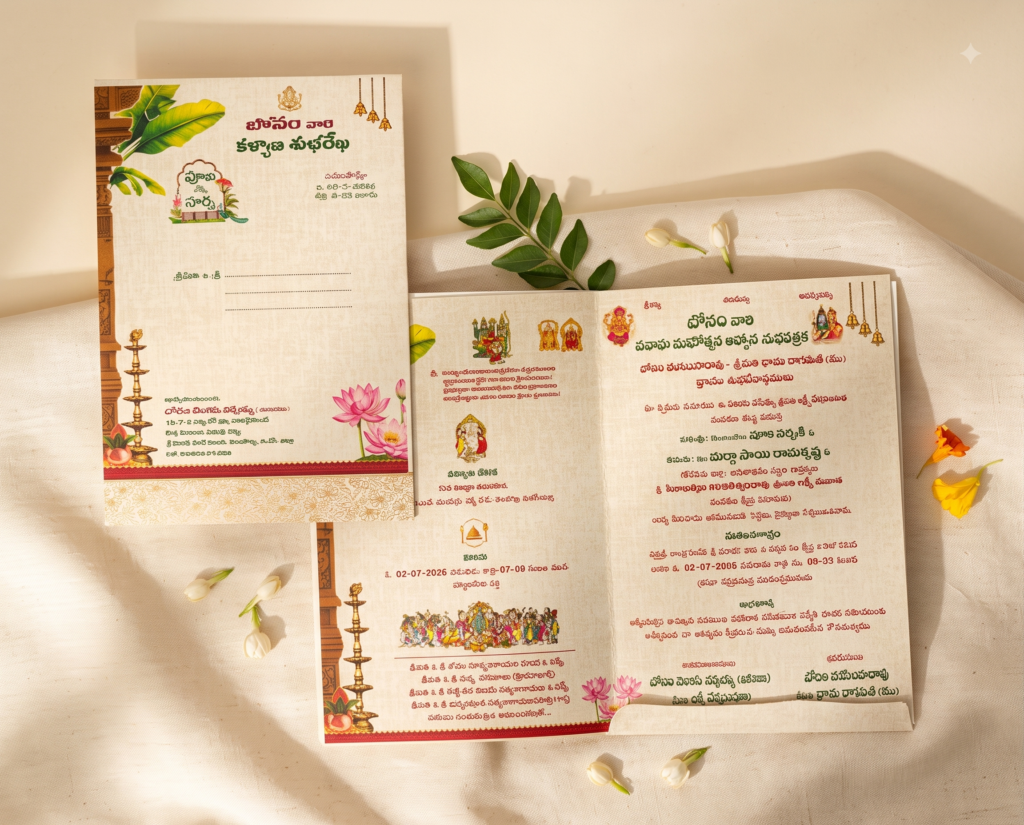
A wedding card is usually the first thing a guest holds in their hands before they’ve met a single member of either family. For a Telugu wedding, that card is a Subhalekha (శుభలేఖ) — literally, an “auspicious letter” — and it carries more than a date and an address. It carries the blessing that opens the celebration, the names of two families joining together, and the small, specific details that tell guests this is their family’s wedding, not a template.
Getting the design right is one job. Getting the wording right is a different one, and it’s the part most couples underestimate — until they’re staring at a proof copy at 11 p.m. wondering whether the Muhurtham time needs “AM” written out, or whether Amma’s name should come before Nanna’s.
This guide walks through what actually belongs on a Telugu wedding invitation, a sample structure you can hand straight to your printer, notes on the ceremonies that often get printed alongside the main card, and the mistakes worth catching before anything goes to press.
What Belongs on a Telugu Wedding Invitation
Most Subhalekhas — whether printed fully in Telugu, fully in English, or bilingually — cover the same core ground. Not every family includes every element below, and that’s fine. Think of this as a checklist to choose from, not a script to follow line by line.
An opening blessing. A short invocation at the top of the card, usually naming a family deity or offering a general auspicious greeting such as “శ్రీరస్తు శుభమస్తు అవిఘ్నమస్తు.” Some families keep this to one line; others open with a longer Sanskrit or Telugu verse tied to their kula daivam.
The couple’s names, introduced through their parents. A traditional card introduces the groom as S/o Sri. [Father’s Name] & Smt. [Mother’s Name] and the bride the same way. A more contemporary card softens this to something like “with the blessings of their parents and families” before naming the couple directly.
Gotram and Nakshatram, for families whose traditions include them. These matter enough that they’re worth confirming twice — once with your purohit and once again on the printed proof, especially if the card is bilingual and the same names need to read correctly in two scripts.
The Muhurtham — the date, day, and exact auspicious time of the ceremony. This is the single most important line on the entire card, and it deserves a final check against your family’s confirmed wedding schedule, not the version that was correct three weeks ago before the priest adjusted the timing.
Venue details, ideally more than just the hall’s name — street, area, city, and a nearby landmark, since a landmark often helps out-of-town guests more than a formal address does. If the reception is at a different location, give it its own clearly separated line.
An RSVP or contact line, usually a phone number or WhatsApp number guests can reach on the wedding day itself, not just during planning.
A closing line, inviting guests to be present and to bless the couple — the note the card leaves them with before they set it down.
A Sample Structure to Work From
If you’re starting from a blank page, this layout gives your printer a clean starting point. Swap in your family’s own blessing line, names, and wording style — the structure below is meant to be adapted, not copied exactly.
[Opening blessing / family deity invocation]
With the blessings of their parents, elders, and well-wishers,
[Groom’s Name]
Son of Sri. [Father’s Name] & Smt. [Mother’s Name]
(Gotram / Nakshatram, if included)weds
[Bride’s Name]
Daughter of Sri. [Father’s Name] & Smt. [Mother’s Name]
(Gotram / Nakshatram, if included)cordially invite you and your family to grace the wedding ceremony and bless the newlyweds.
Muhurtham
[Date, Day] at [Exact Time]Venue
[Venue Name]
[Full Address with Landmark]Your gracious presence and blessings will make our celebration truly special.
With love,
[Family Names]
Telugu, English, or Both?
For many families today, the honest answer is both — a bilingual card lets elders connect with the traditional wording while giving younger guests, especially those living outside Andhra Pradesh and Telangana, the practical details in a language they’ll read quickly.
The wording rarely translates well line by line, so most printed cards handle it one of three ways: a Telugu panel facing an English panel, so each stands on its own; a Telugu-led card with the ceremonial wording in Telugu and only the date, venue, and RSVP in English; or a blended approach that keeps the blessing and family introduction traditional while writing the practical details plainly, in whichever language reads more clearly. None of these is more “correct” than the others — the right choice depends on who’s actually going to be reading the card.
Wording for the Ceremonies Around the Wedding
Telugu weddings rarely travel alone. Several other family milestones are often celebrated in the same season, and each has its own tone.
A Gruhapravesam invitation centers on entering a new home, so the wording tends to be warm and devotional rather than formal — house owners’ names, the new address, the puja date and time, and an invitation to bless the home.
An Upanayanam invitation marks a boy’s sacred thread ceremony. The wording usually leans more Vedic and ceremonial, giving prominence to the child’s name, his family, Gotram where the family includes it, and the exact ceremony timing.
A Seemantham invitation welcomes the next chapter of motherhood, and the wording benefits from being softer and more personal — focused on the expecting mother, her husband and family, and a request for blessings rather than a formal announcement.
A naming ceremony invitation can stay genuinely simple: the baby’s name reveal, the parents’ names, the date and venue, and a short blessing. The occasion is intimate, so the wording doesn’t need to work hard to match it.
Because these cards share a structural skeleton with the wedding invitation, many families print them as a matching set — same paper, same palette, same typography — so the whole season of celebrations feels like one connected story to the guests receiving them.
Before It Goes to Print: A Final Check
A handful of mistakes account for most of the reprints we see, and nearly all of them are catchable with one careful read-through of the actual proof — not the version copied into a WhatsApp message.
Recheck the Muhurtham date and time against the latest confirmation from your family or purohit. Confirm every name’s spelling, including initials and any transliterated spellings, since a name that’s correct in Telugu can still slip in its English transliteration. If Gotram and Nakshatram are included, verify them once more — these are the details relatives notice fastest. Read the venue address for a landmark, city, and PIN code, since a hall name alone isn’t always enough for someone driving in from another town. On bilingual cards, make sure both sides tell the same story — same names, same date, same time, same address. And call the RSVP number before it’s printed on a few hundred cards, just to be certain it rings.
The Wording Should Match the Card
One more thing worth sitting with before you finalize anything: the words and the design should feel like they belong to the same invitation. A deeply traditional card, full of Sanskrit verses and temple motifs, asks for equally traditional wording. A minimal, contemporary card often works better with fewer words and more restraint. Neither is the “better” choice — the right one is whichever feels like your family.
Long before the wedding day itself, the invitation is already doing its job — travelling from home to home, carrying names that have been spoken with affection for years, and the date everyone has been waiting to hear. It’s worth the extra care.
Need help getting your wording and design working together? At Kothapalli Cards, we print wholesale wedding invitations — traditional, floral, luxury, and contemporary — out of Tadepalligudem, along with matching cards for Gruhapravesam, Upanayanam, Seemantham, and naming ceremonies. If you’re still finalizing your wording or your design, message us on WhatsApp and we’ll help you take it from a rough draft to a finished, print-ready card.